What is macular degeneration? Macular degeneration is a common eye disease that affects the macula, the central part of the retina responsible for sharp and detailed vision.
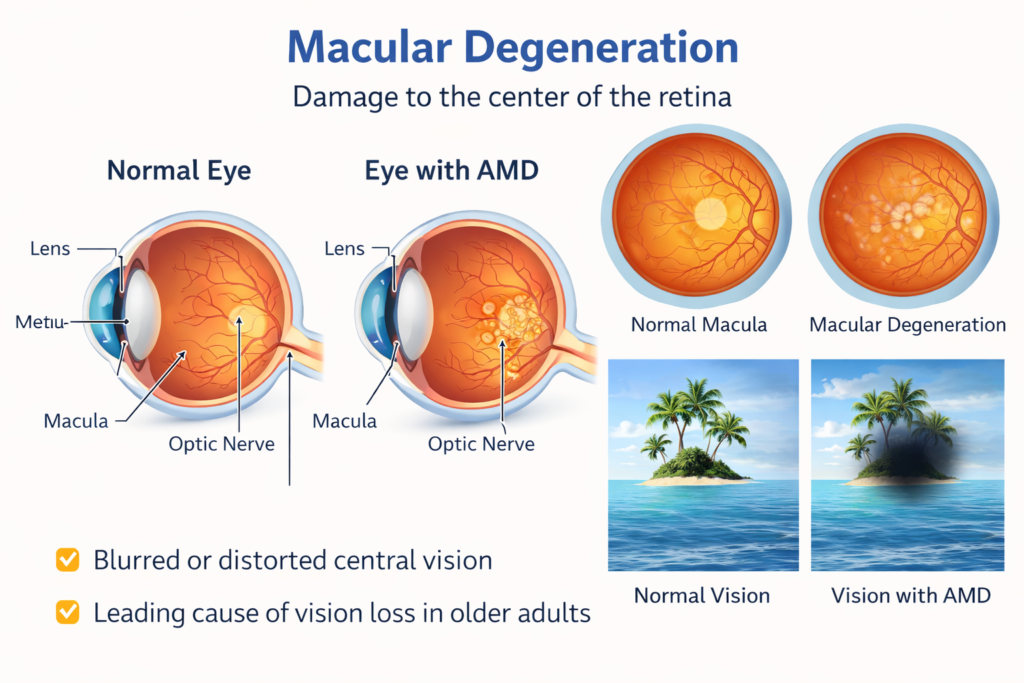
Macula Degeneration
The macula allows us to perform everyday tasks such as reading, driving, recognizing faces, and seeing fine details. When macular degeneration develops, the central vision can become blurred or distorted.
Macular degeneration is most commonly associated with aging and is often called Age-Related Macular Degeneration (AMD). It is one of the leading causes of vision loss in adults over the age of 50.
To understand the role of the macula better, you can also read:
👉 What Is the Macula?
Types of Macular Degeneration
There are two main types of macular degeneration.
1. Dry Macular Degeneration
Dry macular degeneration is the most common form, accounting for about 85–90% of cases.
It occurs when small yellow deposits called drusen accumulate under the retina. Over time, these deposits can damage the cells of the macula and gradually affect central vision.
Dry AMD usually progresses slowly and may not cause noticeable symptoms in the early stages.
👉 Learn more: Dry Macular Degeneration
2. Wet Macular Degeneration
Wet macular degeneration is less common but more severe.
In this type, abnormal blood vessels grow under the retina. These vessels may leak blood or fluid, leading to rapid damage to the macula and sudden vision loss.
Early diagnosis and treatment are very important for wet macular degeneration.
👉 Learn more: Wet Macular Degeneration
Symptoms of Macular Degeneration
Macular degeneration symptoms can vary from person to person. However, common signs include:
- Blurred or distorted central vision
- Straight lines appearing wavy
- Difficulty reading
- Dark or empty areas in the center of vision
- Difficulty recognizing faces
- Colors appearing less vibrant
- Reduced ability to see fine details
An easy way to detect early changes in vision is by using the Amsler Grid Test.
Causes and Risk Factors
Several factors can increase the risk of developing macular degeneration.
Common risk factors include:
- Aging
- Genetics or family history
- Smoking
- High blood pressure
- Obesity
- Long-term exposure to ultraviolet (UV) light
Smoking is one of the strongest risk factors and can significantly increase the likelihood of developing macular degeneration.
External reference:
👉 https://www.aao.org/eye-health/diseases/amd-macular-degeneration
How Is Macular Degeneration Diagnosed?
Eye doctors use several tests to diagnose macular degeneration.
These include:
- Dilated eye examination
- Optical Coherence Tomography (OCT)
- Fundus photography
- Amsler Grid Test
The Amsler Grid Test is a simple method that can help detect early signs of macular problems even at home.
👉 How to Use the Amsler Grid Test
Treatment for Macular Degeneration
Treatment options depend on the type of macular degeneration.
Dry AMD Treatment
Currently, there is no cure for dry macular degeneration. However, the progression may be slowed by:
- Vitamin supplements
- Healthy diet
- Quitting smoking
- Regular eye examinations
Wet AMD Treatment
The most common treatment for wet AMD is:
Anti-VEGF injections
These medications help block abnormal blood vessel growth and may slow vision loss.
Can Macular Degeneration Be Prevented?
Although macular degeneration cannot always be prevented, the risk can be reduced.
Helpful steps include:
- Avoid smoking
- Wear sunglasses that block UV rays
- Eat leafy green vegetables
- Maintain a healthy diet rich in omega-3
- Get regular eye examinations
Frequently Asked Questions
Can macular degeneration cause blindness?
Macular degeneration usually does not cause total blindness. However, it can significantly affect central vision and daily activities like reading or driving.
Who is most at risk?
People over the age of 50, smokers, and individuals with a family history of AMD have a higher risk.
Can macular degeneration be detected early?
Yes. Regular eye exams and tests like the Amsler Grid can help detect macular degeneration in its early stages.